CCNP Enterprise & Service Provider Training
Master MPLS, BGP, OSPF, IS-IS, L3/L2 VPNs, network security (AAA, RADIUS, TACACS+), and spine-leaf architecture for enterprise and SP environments.
Course Overview
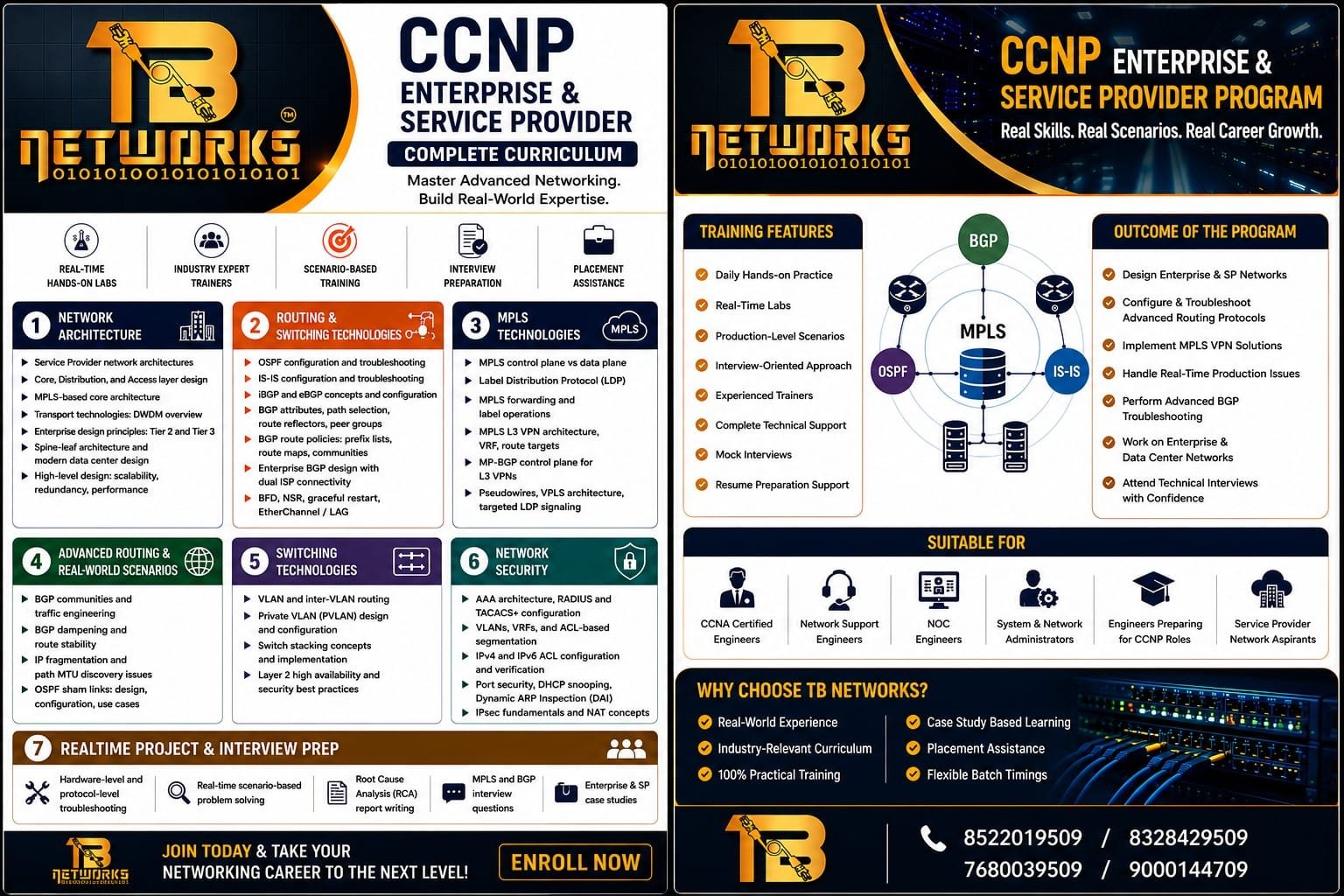
This CCNP training covers both Enterprise and Service Provider networking in depth. You will master MPLS-based core architectures, BGP for dual-ISP and SP environments, OSPF and IS-IS, MPLS L3/L2 VPNs, spine-leaf data center design, advanced network security (AAA, RADIUS, TACACS+, layer 2 security), and real-world troubleshooting. All topics are taught through production-style topologies and hands-on lab scenarios.
What You'll Learn
Detailed Curriculum
Section 1: Network Architecture▼
- →Service Provider network architectures
- →Core, Distribution, and Access layer design
- →MPLS-based core architecture
- →Transport technologies: DWDM overview
- →Enterprise design principles: Tier 2 and Tier 3
- →Spine-leaf architecture and modern data center design
- →High-level design: scalability, redundancy, performance
Section 2: Routing & Switching Technologies▼
- →OSPF configuration and troubleshooting
- →OSPF Virtual Link, OSPF Sham Link, P2P and Passive Interface
- →IS-IS configuration and troubleshooting
- →iBGP and eBGP concepts and configuration
- →BGP attributes, path selection, route reflectors, peer groups
- →BGP route policies: prefix lists, route maps, communities
- →Enterprise BGP design with dual ISP connectivity
- →BFD, NSR, graceful restart, EtherChannel / LAG
Section 3: MPLS Technologies▼
- →MPLS control plane vs data plane
- →Label Distribution Protocol (LDP)
- →MPLS forwarding and label operations
- →MPLS L3 VPN architecture, VRF, route targets
- →MP-BGP control plane for L3 VPNs
- →Pseudowires, VPLS architecture, targeted LDP signaling
Section 4: Advanced Routing & Real-World Scenarios▼
- →BGP communities and traffic engineering
- →BGP dampening and route stability
- →IP fragmentation and path MTU discovery issues
- →OSPF sham links: design, configuration, use cases
Section 5: Switching Technologies▼
- →VLAN and inter-VLAN routing
- →Private VLAN (PVLAN) design and configuration
- →Switch stacking concepts and implementation
- →What is Stacking, VPC, and VSS with live examples
- →Layer 2 high availability and security best practices
Section 6: Overlay & Fabric Technologies▼
- →Overlay vs underlay networking and why fabrics exist
- →VXLAN fundamentals: VTEP, VNI, and MAC-in-UDP encapsulation
- →VXLAN flood-and-learn vs control-plane learning
- →BGP EVPN control plane and EVPN route types
- →VXLAN EVPN in spine-leaf fabrics: distributed anycast gateway
- →L2VNI and L3VNI multi-tenancy and VRF mapping
- →LISP architecture: EID, RLOC, Map Server and Map Resolver
- →LISP control plane, data plane and host mobility
- →LISP in SD-Access and enterprise fabric use cases
- →Labs: VXLAN EVPN fabric build, EVPN route verification, LISP map registration
Section 7: Network Security▼
- →AAA architecture, RADIUS and TACACS+ configuration
- →VLANs, VRFs, and ACL-based segmentation
- →IPv4 and IPv6 ACL configuration and verification
- →Port security, DHCP snooping, Dynamic ARP Inspection (DAI)
- →IPsec fundamentals and NAT concepts
Section 8: Realtime Project & Interview Prep▼
- →Hardware-level and protocol-level troubleshooting
- →Real-time scenario-based problem solving
- →Root Cause Analysis (RCA) report writing
- →MPLS and BGP interview questions
- →Enterprise & SP case studies
Tools & Technologies
Career Opportunities
Service Provider Network Engineer
₹8.0-16.0 LPA
Design and manage MPLS-based SP network infrastructure
Senior Network Engineer
₹7.5-14.0 LPA
Lead enterprise routing, switching, and BGP design
Network Solutions Architect
₹10.0-18.0 LPA
Design comprehensive SP and enterprise network solutions
Course Fee
+ ₹4,140 GST (18%) · Total ₹27,140
Course access is valid for 6 months from the date of enrollment.