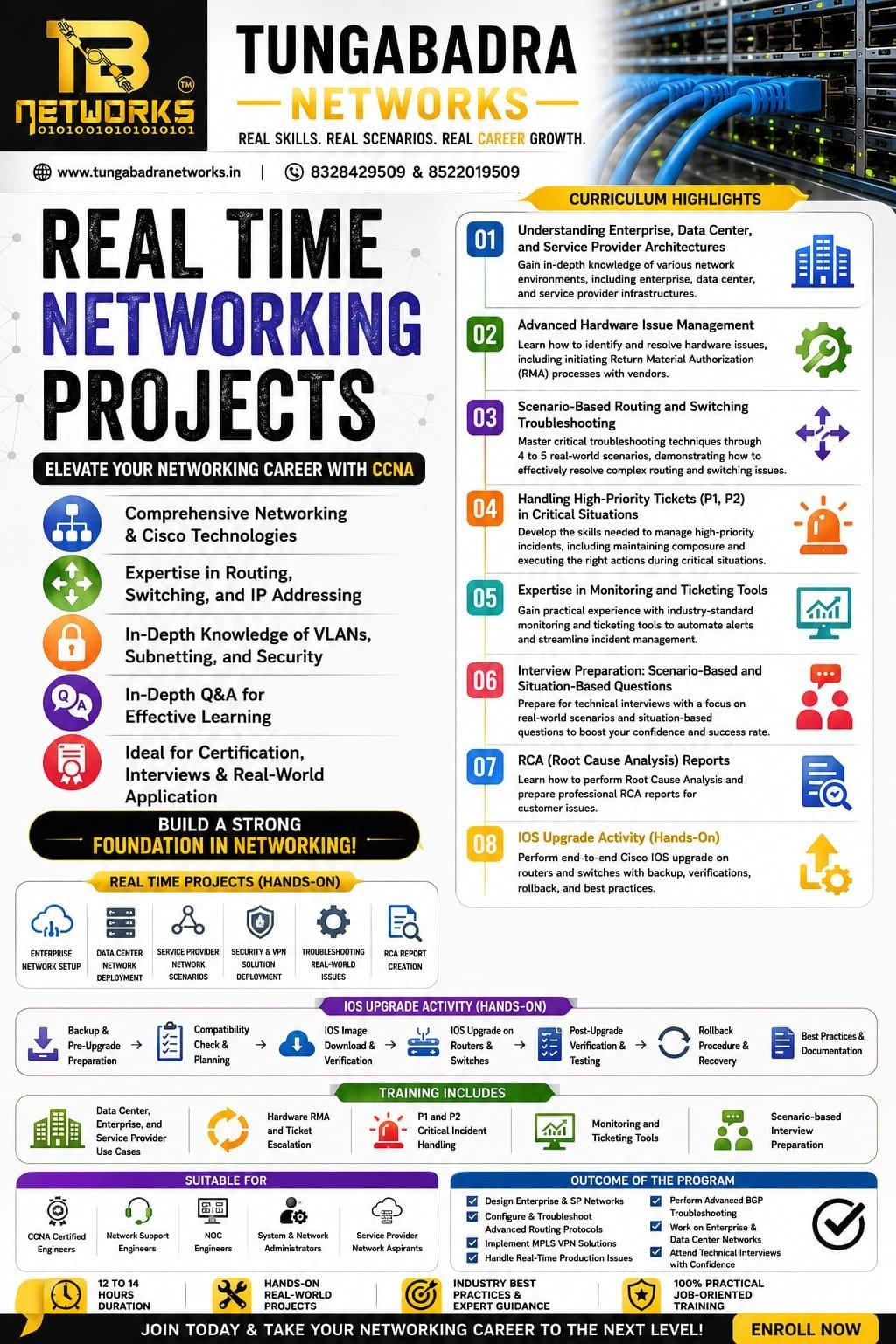
Real-Time Networking Projects
Packet-level, TAC-level, production-focused training for Core Network Engineers. 18 modules covering enterprise, data center, and SP architectures, hardware and protocol troubleshooting, P1/P2 incident handling, monitoring tools, network automation, and interview preparation.
Course Overview
At Tungabadra Networks, this packet-level, TAC-level, production-focused program covers real-world networking projects across enterprise, data center, and service provider environments. Across 18 modules you will work with multi-vendor hardware (Cisco, Juniper, Arista, Aruba), troubleshoot SFP/fiber and interface issues, debug OSPF, BGP, MPLS, and IPsec problems, perform packet captures with Wireshark, handle P1/P2 incidents with war-room communication and RCA reporting, operate monitoring and ticketing tools, and get started with network automation using Python and REST APIs. Dedicated modules guide non-IT candidates through the KT process and map out the career path to Principal Network Engineer, closing with interview preparation and resume building.
What You'll Learn
Detailed Curriculum
Module 1: Network Architectures▼
- →Enterprise Network Architecture (Small / Medium / Large scale)
- →Service Provider Architecture (Core, Distribution, Access)
- →Data Center Architecture (3-Tier vs Leaf-Spine)
- →High Availability design concepts
- →Traffic flow: North-South vs East-West
Module 2: Network Devices & Vendors▼
- →Cisco devices (ASR, ISR, Catalyst)
- →Juniper devices (MX, SRX, QFX)
- →Arista switching (Data Center)
- →Aruba (Access & Wireless)
- →Hardware components: Line Cards, RSP, IOM, Fabric Modules
- →SFP types and compatibility
Module 3: Hardware-Level Troubleshooting▼
- →SFP troubleshooting (Tx/Rx power, DOM analysis)
- →Fiber issues: bending, splicing, cleaning
- →CRC errors and input error analysis
- →Interface flapping / down issues
- →Device health checks
- →RMA process (real-time workflow)
Module 4: Routing & Protocol Troubleshooting▼
- →Static routes and default route issues
- →IP SLA configuration and tracking
- →OSPF troubleshooting: LSA Types (1–5), neighbor issues, virtual links
- →BGP troubleshooting: path selection, route reflectors, prefix advertisement issues
Module 5: Network Reachability Troubleshooting▼
- →End-to-end connectivity issues
- →Layer 2 vs Layer 3 isolation techniques
- →ARP, MAC table, and routing table analysis
- →VLAN and trunk issues
- →Server reachability problems
Module 6: DNS & Application Troubleshooting▼
- →DNS resolution flow
- →Forward and reverse lookup issues
- →Real-time DNS failures
- →Application slowness analysis
Module 7: Advanced Troubleshooting Tools▼
- →Traceroute deep dive
- →MTR (My Traceroute) analysis
- →Packet capture basics (Wireshark)
- →TCP deep dive: 3-way handshake, retransmissions, windowing issues
Module 8: Switching & Security Issues▼
- →Port security violations
- →Err-disable troubleshooting
- →STP basics (including MST concepts)
- →Broadcast storm handling
Module 9: Monitoring & Ticketing Tools▼
- →Monitoring tools: SolarWinds, Nagios, Zabbix, Cisco Prime
- →Ticketing tools: ServiceNow, Remedy
- →SNMP concepts: SNMPv2 vs SNMPv3, OIDs and polling
- →Adding devices to monitoring tools
- →Alert handling and escalation
Module 10: Production Environment Learning▼
- →What to ask after joining a company: HLD, LLD, network diagrams, internal tools access
- →Change management process
- →Incident management (P1 / P2 handling)
- →SLA and escalation matrix
Module 11: Advanced Networking Concepts▼
- →MPLS advanced troubleshooting: LDP / RSVP issues, L3VPN debugging
- →VRRP and HSRP real-time issues
- →NAT troubleshooting
- →IPsec VPN troubleshooting (Phase 1 & Phase 2)
Module 12: TAC-Level Operations▼
- →Bug identification process
- →Vendor TAC case handling
- →Core dump basics
- →Log collection and debugging
Module 13: Network Maintenance Activities▼
- →IOS upgrade procedures
- →Pre-check and post-check validation
- →Configuration change activities
- →Rollback planning
Module 14: Documentation & Processes▼
- →MOP (Method of Procedure)
- →SOP (Standard Operating Procedure)
- →Technical documentation creation
- →Incident reporting
Module 15: Real-Time Incident Handling▼
- →Handling critical incidents (P1 / P2)
- →War room communication
- →Root Cause Analysis (RCA)
- →Preventive measures
Module 16: Network Automation▼
- →Introduction to automation
- →Python basics for network engineers
- →API concepts (REST APIs)
- →Configuration automation (basic level)
Module 17: KT Process & Guidance for Non-IT Candidates▼
- →What is KT (Knowledge Transfer) and why it is important
- →How to approach KT sessions as a beginner
- →Key questions to ask during KT: architecture, HLD/LLD, core/distribution/access devices, vendors, protocols (OSPF, BGP, MPLS)
- →Key questions to ask during KT: traffic flow, critical devices and links, common issues, monitoring and ticketing tools, P1/P2 escalation matrix
- →Understanding network diagrams step-by-step
- →How to take notes during KT effectively
- →How to build your own network understanding document
- →Common mistakes freshers make during KT
- →How to become independent quickly in a production environment
Module 18: Career Growth Path▼
- →How to become a Principal Network Engineer (PNE)
- →Skills required beyond TAC level
- →Interview preparation
- →Resume building guidance
Tools & Technologies
Career Opportunities
NOC Engineer
₹3.5-6.0 LPA
Monitor network infrastructure and handle P1/P2 incident tickets
Network Support Engineer
₹4.5-8.0 LPA
Troubleshoot routing, switching, and hardware issues end-to-end
Senior Network Engineer
₹7.0-14.0 LPA
Lead real-time troubleshooting and RCA reporting for enterprise clients
Course Fee
+ ₹3,960 GST (18%) · Total ₹25,960
Course access is valid for 6 months from the date of enrollment.